# MaterialBuilder: Compiling materials for source engine
Table of Contents
Writing a .vmt by hand means knowing exactly which shader you’re targeting, which parameters it actually exposes, and getting every texture referenced by it compiled and pointed at the right relative path. Get any of that wrong and the error only shows up later, in-engine, as a missing texture or a silently ignored parameter.
MaterialBuilder takes a KeyValues script instead and produces a validated .vmt, catching mistakes — an unknown shader, a parameter that shader doesn’t support — at compile time instead of at runtime.
resourcecompiler.exe "Y:\buildworker\tssr_rel_win64\content\platform\materials\models\dev\dev_uv_check.vmtbuilder"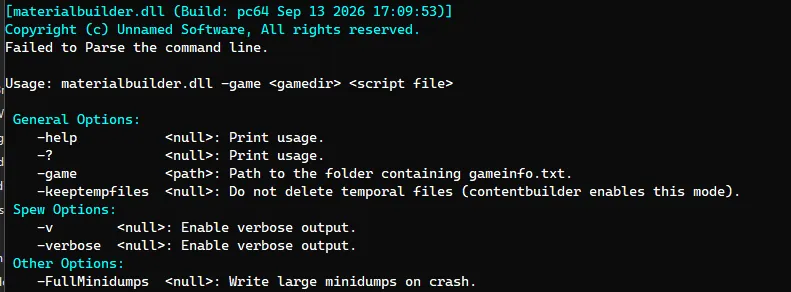
Two builders, one tool
MaterialBuilder picks its behavior from the input script’s extension:
.vmtbuilder→CMaterialBaker— builds a full material..vtfbuilder→CTextureBaker— builds a single texture, standalone.
Both implement the same IBaker interface (Init → ParseScript → Create → Compile → Destroy), so the entry point in materialbuilder.cpp doesn’t need to know which one it’s driving — it just new’s the right one based on the file extension and runs the same four-step sequence.
Validating against the live shader list
A .vmtbuilder script names a shader and a set of $-prefixed parameters:
"MaterialBaker"{    "Shader" "UnlitGeneric"
    "$BaseTexture"    {        "R"     { "R"   "background_color.png" }        "G"     { "G"   "background_color.png" }        "B"     { "B"   "background_color.png" }        "A"     { "A"   "background_color.png" }
        "VtexConfig"        {            "Preset"    "Color"        }    }
    "%KeyWords" "dev, matsys, internal"}
Before writing a single line of .vmt, CMaterialBaker::ParseScript checks the "Shader" value against g_pMaterialSystem’s live shader list (ShaderCount() / GetShaders()) — not a hardcoded list, but whatever materialsystem.dll actually reports at runtime. If the shader doesn’t exist, it fails immediately with the shader’s name in the error.
Every $parameter under it goes through the same check against that specific shader’s declared parameters (GetParamName()), so a typo’d or misplaced parameter is caught the same way. Because a chunk of parameters — $translucent, $nocull, $vertexcolor, $alpha, and about forty others — are handled by the material system itself rather than declared per-shader, those are matched against a static exclusion table instead of the shader’s own param list, so they don’t get rejected as unknown.
Once a parameter passes validation, CMaterialBaker reads its ShaderParamType_t from the shader and writes it into the output .vmt KeyValues tree as the matching type — texture, int, color, vec2/3/4, float, bool, string, or material. Two now-obsolete types (ENVMAP, FOURCC) just get a warning instead. Anything prefixed with % instead of $ — like %KeyWords above — isn’t a shader parameter at all, so it’s copied through untouched; those exist for other tools like Hammer and VBSP/VRAD to read.
Example of a material with a unknow shader:
Example of a material with a unknow shader parameter:
Texture parameters: reference or generate inline
A texture-typed parameter like $BaseTexture has two ways to resolve:
- Point at an existing
.vtfbuilder. MaterialBuilder compiles it as a child texture and rewrites the parameter to point at the resulting.vtf. - Define it inline, as in the example above — a
TextureBakersub-block describing which source image channels go into which destination channels. MaterialBuilder writes that block out to a temporary.vtfbuilderfile and compiles it the same way, throughCTextureBaker::CompileChildren. Each material that defines the texture/s as inline owns the texture, this means that is not used in any other material, this will become later very useful for the assetsystem system to detect orphan textures.
Either way it’s the same texture compiler underneath — a material never has its own bespoke texture-building code path, it just drives CTextureBaker on the material’s behalf.
An AnimatedTextureBaker sub-block is also recognized in the script format, for frame-sequence textures — but the implementation is still a stub (CAnimatedTextureBaker only implements Identifier() right now). Referencing one in a script currently just errors out; it’s next on the list.
The channel compositor
CTextureBaker is the piece that turns a Channels block into an actual image:
"TextureBaker"{    "Channels"    {        // <destination vtf channel> { <src image channel>  <path to the src file> }        "R"     { "R"   "mask_specular.png" }        "G"     { "G"   "mask_specular.png" }        "B"     { "B"   "mask_specular.png" }    }
    "VtexConfing"    {        "Preset"    "Color"    }}
Each destination RGBA channel can pull from a different source image’s channel — the classic Source Engine trick of packing unrelated grayscale masks (specular, AO, roughness) into one RGBA texture instead of shipping four separate files. CGeneratedImage loads every referenced source image with stb_image, checks that all of them share the same resolution, allocates a zero-filled destination buffer sized for however many channels ended up being used, and copies each source channel into its destination slot one pixel at a time.
The composited result is written out as an intermediate .tga via stb_image_write, and vtex.dll is called in-process (g_pVtex->VTex(...)) to compile that .tga into the final .vtf. Vtex’s own compile flags come from a VtexConfig block — either a named preset resolved from materialbuilder_settings.txt (VtexConfigPresets), or ad-hoc Param overrides — written to a companion .txt file that vtex.exe’s config format expects.
When a texture is compiled as a child of a material rather than standalone, one more thing happens after vtex finishes: MaterialBuilder reopens the freshly compiled .vtf and stamps a small resource chunk into it (VTF_RSRC_CHILDREN_TEXTURE_FROM_MATERIAL) recording the parent material’s name. That’s what lets a generated child texture be told apart from one with its own independent .vtfbuilder script later — useful for tooling like ContentCheck that walks the asset cache and needs to know whether a .vtf is meant to be edited directly or regenerated from its owning material.
Temp files and cleanup
Both bakers stage their work in a temp directory next to the source script (_vmtbuilder\ or _vtfbuilder\) and delete it once the compile succeeds. -keeptempfiles skips the cleanup — ContentBuilder enables this mode when it drives MaterialBuilder as part of a larger batch, so intermediate .tgas and vtex config files can be inspected if something in the chain goes wrong.
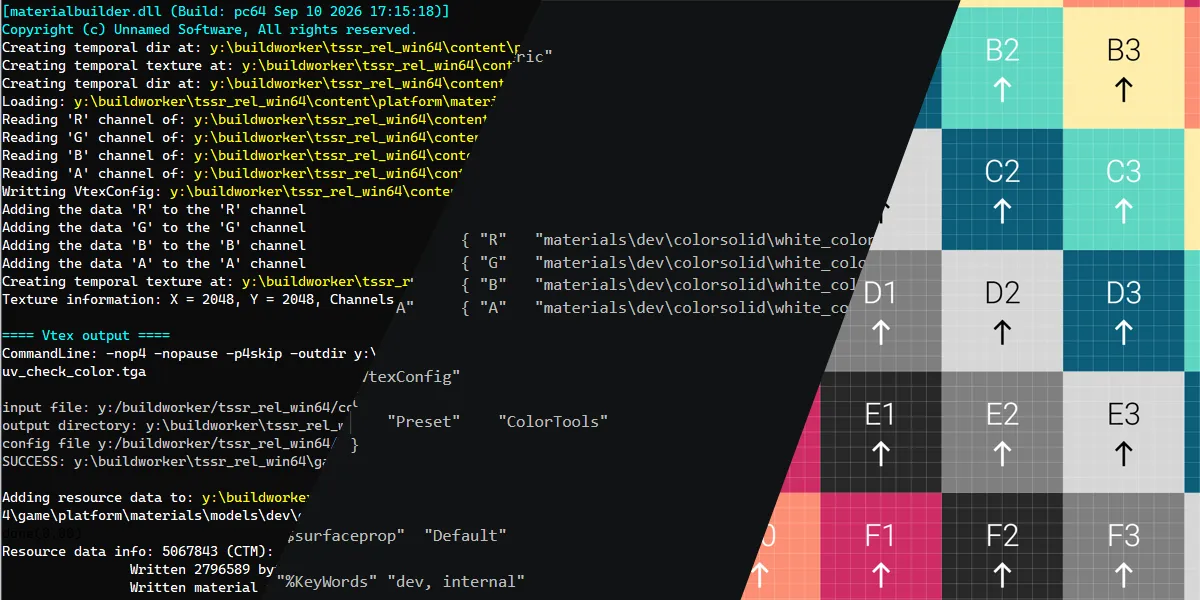
Example in action
Why this matters for a pipeline
A shader’s valid parameter set changes as materialsystem.dll evolves, and channel-packing textures by hand in an image editor doesn’t scale past a handful of materials. MaterialBuilder ties both to the config file: the script describes intent — which shader, which parameters, which channels from which source images — and the tool resolves that against whatever the engine currently supports, failing loudly at compile time instead of leaving a broken material to be discovered later.
MaterialBuilder will be later used by Material Editor the UI tool for creating and rendering the materials for artists.
Part of an ongoing series on the custom Source Engine tooling I’m building for my game. More tools and systems coming.